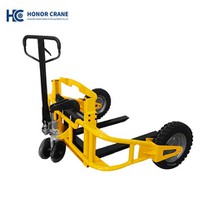
As a crucial material handling equipment in industrial warehousing and logistics sites, the quality of four-wheel forklift operation directly impacts operational safety, equipment lifespan, and logistics efficiency.Due to the advantages of a four-wheel structure in load-bearing capacity and driving stability, operation requires adherence to more rigorous procedures to meet the challenges of heavy loads and variable working conditions. Mastering scientific and standardized operating methods is an essential professional quality for every operator.
Preparation before operation is fundamental to ensuring safety. Operators should check fuel or battery power, hydraulic fluid level and quality, coolant and brake fluid levels in advance, confirming they are within the normal range; check tire pressure and wear, remove foreign objects from the tire treads to prevent slippage or tire blowouts. The lights, horn, warning devices, and braking system should be functionally verified to ensure responsiveness. For internal combustion forklifts, pay attention to exhaust pipe unobstructed flow, belt tension, and filter cleanliness; for electric forklifts, check the integrity of cables and connectors. Obstacles should be cleared from the work area to ensure sufficient width for turning radii, and warning signs should be placed on slopes or slippery sections.
A smooth start and drive should be maintained. Before starting, ensure the gear is in neutral or park and the parking brake is engaged. Internal combustion engine vehicles need to be preheated to a suitable speed; electric vehicles should have their battery level checked and the control system preheated. During driving, speed should be controlled appropriately according to site conditions. Maintain a constant speed on straight roads, and reduce speed in advance when turning, on slopes, and in densely populated areas to avoid sudden turns or braking that could cause load swaying or even tipping. When carrying goods, the forks or attachments should be securely fixed to drums or pallets, the center of gravity should be kept as centered as possible, and the height lowered to improve driving stability. Travel in a straight line when going uphill or downhill; do not shift gears arbitrarily when going uphill, and do not coast in neutral when going downhill; use auxiliary braking when necessary.
Loading and unloading operations emphasize precision and safety. When approaching the target location, slow down and align, using the hydraulic system to slowly raise or lower the load; avoid applying sudden pressure. When placing goods in the designated location, lower them slowly to a few centimeters above the ground and pause to ensure stability before fully releasing the supports to prevent slippage or tipping. For flammable, corrosive, or fragile items, use specialized attachments and wear protective gear. Ensure good ventilation in the work area to prevent hazards caused by static electricity or leaks.
After operation, perform routine maintenance. Lower the forks to the lowest position, turn off the power source, engage the parking brake, and remove the key or lock the power switch. Clean the vehicle body and attachments of oil and dust, check for abnormal wear or leaks, and replenish lubrication and check fluid levels according to the maintenance procedures. If any malfunction or potential problem is found, report it immediately and stop using the vehicle for repair; never operate a malfunctioning vehicle.
In summary, the operation of a four-wheeled forklift covers aspects such as work preparation, driving control, loading and unloading procedures, and post-operation maintenance. Only by strictly adhering to these procedures can personnel safety be ensured while fully utilizing the equipment's performance and providing continuous and reliable support for industrial material handling.