< img height="1" width="1" style="display:none" src="https://www.facebook.com/tr?id=4535971103301525&ev=PageView&noscript=1" />
Shandong Honor Crane Lifting Equipment Co., Ltd.
+8619053819325
Your Professional Lift Table Manufacturer & Supplier


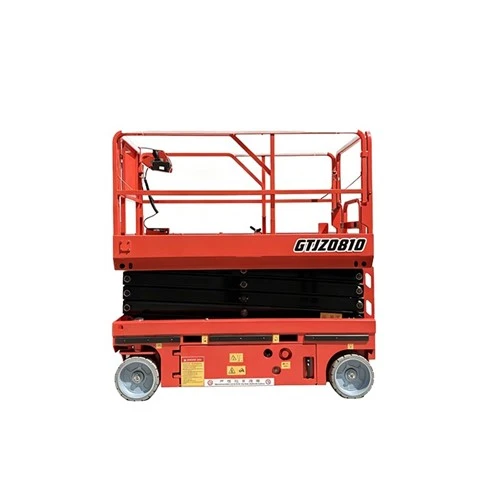
Shandong Honor Crane Lifting Equipment Co., Ltd, established in 2014, is a specialized manufacturer dedicated to the R&D, production, and global sales of lifting equipment. Boasting a modern manufacturing facility spanning over 3,000 square meters, we possess an annual production capacity exceeding 1,000 sets of lifting equipment. Our product range includes:Hydraulic Scissor Lifts, Mobile Scissor Lift Platforms, Self-Propelled Scissor Lifts, Electric Forklift Truck, Dock Levelers, Customized Lifting Platforms.


Why Choose Us


Advanced Equipment

We are equipped with CNC cutting machines, automated welding systems, hydraulic testing systems, painting production lines, and load testing equipment, thereby ensuring precision in our manufacturing processes and stability in product quality.


Quality Control

From raw material selection, structural fabrication, and hydraulic assembly to final inspection and testing, every stage is subject to rigorous management and control to ensure product safety, durability, and stable long-term performance.


Global Market Experience

Our products are exported to numerous regions—including Europe, Southeast Asia, the Middle East, South America, and Africa—allowing us to accumulate extensive experience in cross-regional technical adaptation, localized service provision, and regulatory compliance.


Specification


Product Name

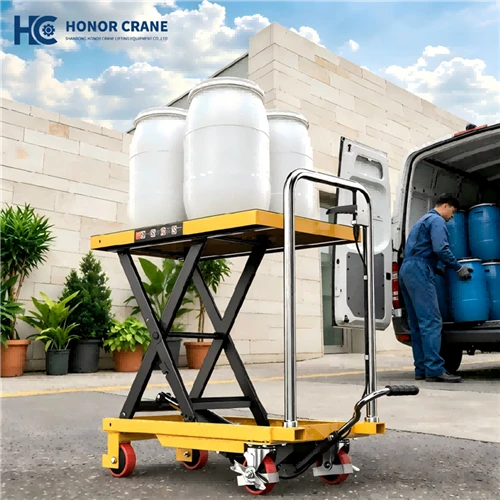
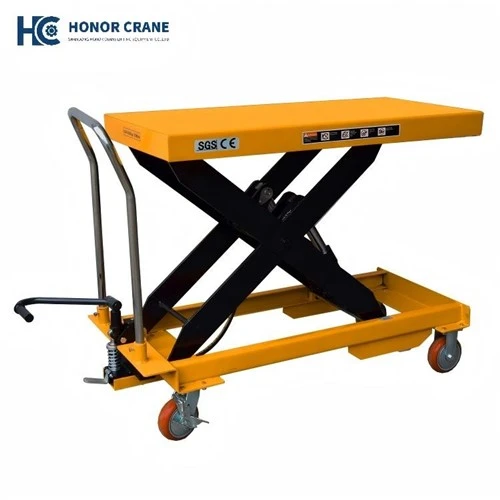
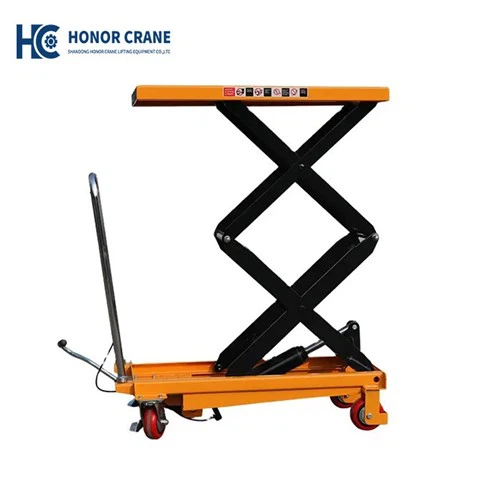
Manual Hydraulic Lift Table

Load capacity (kg)

300kg

Max Lifting Height

900mm

Power type

Manual lifting

Color

Yellow and also can customized

Self Weight (kg)

140kg

Min Lifting Height

280 mm


Key Features of Lift Table

Stable platform
Unlike hoists, cranes, or manipulators, lift tables provide a stable platform for lifting and lowering materials. The chance of accidentally dropping a work piece is dramatically decreased, and the danger of a suspended load swinging and causing injury to workers is eliminated.
Infinite height adjustment
A lift table is designed to smoothly move up or down to any desired height and to maintain that height even if there is a power failure.
Versatility
Lift tables can be provided with a wide range of options such as conveyor platforms, tilting platforms, and platforms with special fixturing such as clamps and automatic work positioning devices.
Programmable movement
A lift table's movement can be programmed and integrated into special handling systems.
Portability
Lift tables can be provided in portable configurations using wheels or casters and in semi portable configurations using a THC (truck handling chassis).
Wide vertical range
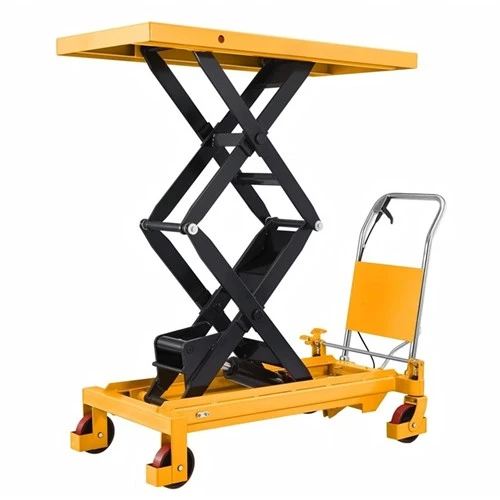
A lift table can be installed in pits to make the lowered height leveled with the height of the floor or, if some extra height is needed, a lift table can be provided with multiple scissor legs for high lifting. Another option is the low profile lift table. Because of the low collapsed height, a low profile lift table needs no pit installation as they can be placed directly on the floor.
Low maintenance
Lift tables are rugged, heavy-duty machines designed to provide years of reliable service with minimum maintenance.

手动液压升降台


Key Components of Lift Table


Platform
The platform can be of any size that is compatible with the lift tables base frame and the scissors. However, the platform cannot be smaller than the length or width of the scissors or the base frame. But it can be higher and wider than the scissors and/or the base frame. Platforms can be furnished with a variety of options such as conveyor tops, turntables, tilt tops or tops equipped with clamps or special work fixtures.
Scissor mechanism
The scissors of a lift table provide a straight and steady vertical motion while supporting the platform. The two sets of scissor legs are connected by shafts at the center pivot points and upper and lower hinged ends.
Base frame
The base frame supports the rest of the lift table. It has to be strong, rigid and stable. ​In most cases it is designed to be placed on the floor but it can also be built into a pit, supplied with wheels or casters or furnished with a fork lift chassie.
Hydraulic system
The lift tables power pack (most commonly electro hydraulic) consists of an electric motor, hydraulic pump, hydraulic tank, hydraulic cylinder, piping, valving and the electrical control system. When the UP button is activated, the pump pumps fluid from the tank into the cylinders causing the piston and shaft to move. The piston shaft is mechanically linked to the leg assemblies and drives them to raise the platform. The weight of the platform and gravity combine to create pressure in the cylinder that forces the fluid to flow back to the reservoir. A check valve in the hydraulic line between the pump and the cylinder prevent fluid from flowing backwards so the platform will remain at whatever height it is at when the UP button is deactivated. When the DOWN button is deactivated, the lowering valve closes and the table's height becomes fixated. The valve arrangement prevents the table from lowering if there is a power failure.
Control unit
The standard control unit can either have a push-button function or a foot control function.


Types of Lift Table
 

Manual Lift Tables

Manual lift tables represent the most straightforward type of industrial lift table, primarily designed for handling lighter loads and applications that do not require frequent lifting. They are widely used for their reliability, durability, and minimal maintenance needs. Manual scissor lift tables use mechanical means—like a crank, ratchet, screw jack, or hydraulic hand pump—operated by hand or foot pedal to raise or lower the platform. These ergonomic lifting devices are ideal for assembly lines, packaging workstations, and light-duty material handling tasks where power access is limited.


Pneumatic Lift Tables

Pneumatic lift tables utilize a pneumatic air lift system powered by compressed air, eliminating the need for an electrical power source or hydraulic fluids. An air compressor delivers the lifting force, making pneumatic-powered lifting tables highly portable, energy-efficient, and easy to relocate. Unlike hydraulic models, pneumatic lift tables do not use oils, lubricants, or other fluids in their lifting mechanism, eliminating the risk of contamination and making them especially suitable for cleanrooms, pharmaceutical manufacturing, food and beverage processing, electronics assembly, and other environments with strict sanitation standards.

Hydraulic Lift Tables

Hydraulic lift tables are among the most common and versatile industrial lift tables on the market. They rely on a hydraulic system to adjust the platform's height, typically by pumping hydraulic fluid into or out of cylinders connected to a set of scissor legs. As fluid is forced into the cylinder, the scissor mechanism elevates the table, providing powerful lifting capabilities. Hydraulic lift tables are typically electrically powered but may also feature manual or battery operation for mobile configurations.

Electric Lift Tables

Electric lift tables use powerful electric motors, operating on either direct current (DC) or alternating current (AC), to automatically raise and lower the lifting platform with the push of a button. These electrically powered lift tables may be plugged into an electrical outlet or powered via on-board rechargeable batteries for greater flexibility and mobility. Safety features such as emergency stop switches, overload protection, and remote controls ensure operator security and ease of use.


液压升降台


Industries That Utilize Lift Table

Foundry: Lift tables are used to move heavy raw metal and cast components.
Plastics: Lift tables are used in manufacturing and maintaining molding equipment, including injection mold machinery, as well as for moving large volumes of plastic components.
Railroad: Rails, train cars, maintenance equipment, and cargo are all heavy and challenging to transport. Lift tables may help rail facilities quickly move these components for use or repair.
Food: Food and beverage processing plants use lift tables to manage heavy equipment and to load heavy shipments after production.
Aerospace: Like the rail industry, the aerospace industry relies on many heavy components that can be challenging or impossible to transport by hand. Lift tables facilitate the positioning and loading of aircraft parts during manufacturing, maintenance, and certain day-to-day operations.
Metal Processing and Material Handling: The metal processing and material handling industries make extensive use of lifting and positioning equipment to expedite the movement of heavy raw materials and finished products.
Recreational Vehicles: Heavy-duty table lifts offer an easy mechanism for lifting recreational vehicles for storage, finishing, or maintenance.
Automotive: Heavy-duty table lifts assist auto manufacturers and mechanics in preparing and servicing vehicles.
Paper: Paper manufacturers, printers, and packagers all use table lifts to help position and transport heavy reams of paper.
Manufacturing: Table lifts are a staple of manufacturing, used in plants of all types to help employees manage loads quickly and safely.
Electronics: The electronics industry uses table lifts with Electrostatic Discharge (ESD) to efficiently move large electronics without damaging sensitive circuitry.


Lift Table Customization


Load Capacity Options

Different load capacities available to meet various lifting and material handling requirements.

01

Platform Size Customization

Platform length, width, and height can be adjusted according to different applications.

02

Lifting Height Options

Different lifting heights are available for warehouse, factory, and loading operations.

03

Structure & Function

Manual, hydraulic, and electric lift table types can be customized for different working environments.

04

OEM Service

Logo, color, voltage, and packaging can be customized for brand and market requirements.

05


Packaging and Shipping


Packaging

Carton box and plastic wrap

Transportation methods

Road transport, rail transport, sea transport


FAQ


Q: What does a lift table do?

A: A lift table is a material handling device used to raise and lower heavy loads to a desired working height. It typically uses a scissor-style lifting mechanism powered by hydraulics, air, or mechanical systems to safely move materials between different elevations.

Q: What are the alternatives to a lift table?

A: Forklifts are the most prevalent alternative to lift tables. Typically lift tables can be found at truck depots to assist moving items off trailers by raising/lowering items to working heights.

Q: What are the weight limits for lift tables?

A: Standard lift tables are those in which the capacity is between 2,000 and 6,000 lbs, have a lowered height around 7", vertical travel of 24" to 60" and platform widths of 24" to 72".

Q: How do lift tables work?

A: The majority of lift tables have an electro/hydraulic operating system. An electric lift motor drives a hydraulic pump which raises the lift table; the load is held in position when the motor activation is discontinued, activating a solenoid valve lowers the lift table.

Q: What materials are lift tables made from?

A: Many lift tables can be made with stainless steel, special bearings, and with power supply's to meet a variety of industry specific environmental compliance standards.

As one of the most professional lift table manufacturers and suppliers in China, we're featured by quality products and good service. Please rest assured to buy high-grade lift table at competitive price from our factory.

(0/10)

clearall