


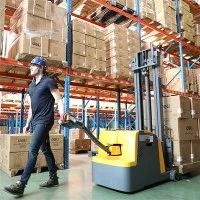

A lifting platform is a mechanical device whose core function is to achieve vertical or inclined lifting. It is widely used in industrial manufacturing, warehousing and logistics, construction, and public services. Through mechanical, hydraulic, or electric drive systems, it smoothly transports personnel, goods, or equipment to a designated height, compensating for the spatial limitations of planar transportation and becoming an indispensable auxiliary equipment in modern operational systems.
The core structure of a lifting platform includes the load-bearing platform, lifting mechanism, drive system, and control system. The load-bearing platform is mostly made of high-strength steel or aluminum alloy, with an anti-slip surface treatment. It can be designed as a flatbed, guardrail, or cargo box type to adapt to different loads and work objects. Lifting mechanisms are classified according to technical approach into scissor lifts, guide rail direct-drive lifts, screw lifts, and rope-driven lifts. Scissor lifts are known for their compact structure and smooth lifting, and are widely used for indoor low-altitude operations; guide rail direct-drive lifts have a large stroke and high load capacity, and are commonly found in heavy-duty industrial scenarios. Drive systems include hydraulic drives, electric screw drives, and pneumatic devices, each suitable for different load, speed, and accuracy requirements. The control system integrates an operation panel, limit switches, and safety valves to ensure adjustable speed, precise positioning, and overload protection during lifting.
Based on application, lifting platforms can be divided into two main categories: fixed and mobile. Fixed lifting platforms are mostly installed in production workshops, warehouses, or docks, undertaking tasks such as fixed-point high-level loading and unloading and material replenishment for production lines. They are often linked with conveyor lines or racking systems to form a continuous workflow. Mobile lifting platforms are equipped with wheels and steering mechanisms, offering high flexibility and allowing for rapid relocation in construction sites, exhibition hall maintenance, or multi-point service scenarios, improving equipment utilization. Furthermore, for special environments, explosion-proof, corrosion-resistant, and insulating models are available to meet the stringent requirements of high-risk or high-cleanliness industries such as chemical, power, and marine engineering.
The value of lifting platforms lies in overcoming height limitations and optimizing vertical transportation efficiency and safety. Compared to traditional scaffolding or manual handling, they can complete precise lifting within seconds, significantly reducing workload and the frequency of high-risk climbing, and providing stable support for heavy equipment maintenance, high-altitude installation, and the stacking of large goods. With the integration of intelligent technologies, some models have achieved remote control, status monitoring, and fault early warning, further enhancing operational controllability and management precision.
As a key piece of equipment connecting different operational levels, lifting platforms, with their diverse structural forms and wide adaptability to various scenarios, continuously provide safe, efficient, and reliable vertical transportation solutions for various industries, helping modern operational systems move towards three-dimensional and intelligent systems.


