


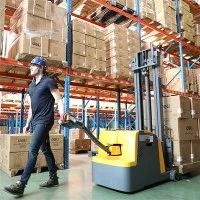

In warehousing and industrial operations, lift trucks have evolved into various forms to meet different working conditions and needs. These models differ significantly in structure, drive system, performance parameters, and applicable scenarios. Understanding these differences helps users make accurate selections based on their operational goals, improving equipment efficiency.
Structurally, lift trucks can be categorized into scissor lifts, mast lifts, and mast lifts. Scissor lift trucks use a cross-hinged frame for lifting, featuring a large platform area and stable lifting, often used for high-level operations requiring the support of multiple people or large areas of materials. Mast lift trucks use a vertical mast with chains or hydraulic push rods for lifting, offering a compact structure and a longer lifting stroke, suitable for stacking scenarios involving pallets and racks. Mast lift trucks use single or double masts for support, occupying less space and enabling high-level positioning in extremely narrow aisles, commonly found in dense warehousing environments.
Differences in drive systems directly affect operating modes and energy efficiency. Manually operated lift trucks rely on manually operated hydraulic pumps, requiring no external power source and resulting in low purchase and maintenance costs. However, their lifting speed and continuous operating capacity are limited, making them suitable for light-load, low-frequency high-level access. Electric lift trucks are powered by battery-driven hydraulic or electric motor systems, offering adjustable lifting speed and travel capabilities. They are highly efficient and labor-saving, making them a common choice for medium- to high-frequency indoor operations. Internal combustion engine-powered lift trucks use a fuel engine, providing high torque and long range, making them suitable for outdoor or heavy-load conditions. However, noise and emissions need to be controlled.
Differences in performance parameters lie in rated load, maximum lifting height, and operating accuracy. Light-duty lift trucks typically have a rated load of several hundred kilograms and a lifting height within 1.5 meters, offering relatively wide positioning accuracy. Heavy-duty or high-level lift trucks can have loads of several tons, lifting heights exceeding 4 meters, and are equipped with height sensors and limit devices to ensure precise alignment with shelf panels.
The differences in application scenarios are also quite significant: scissor lifts are mostly used for maintenance, installation, and other situations requiring a wide platform; mast lifts fit the standardized stacking processes of warehousing; and mast lifts serve high-density racking areas with limited space. Furthermore, in special environments, customized models such as explosion-proof and cold storage types are needed to meet safety and weather resistance requirements.
In summary, the multiple differences in structure, drive system, performance, and applicability of lift trucks constitute their rich product portfolio, providing users with multi-level choices from general-purpose to specialized, and offering targeted guarantees for efficiency and safety in different operating scenarios.


