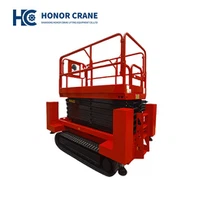
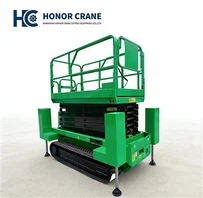
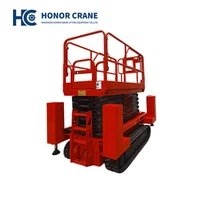
Scissor Lift
1. Crawler Tracks for Rough Ground
Fitted with a tracked undercarriage, this lift travels smoothly across uneven ground, soft soil and muddy sites. It works well in locations where wheeled access platforms have trouble moving.
2. Powered Travel
Self-propelled design lets you shift the lift between different work zones quickly. The machine may only be driven when set up exactly as the manufacturer requires.
3. Vertical Scissor Lift
The scissor structure lifts the platform vertically, ideal for installation, inspection, repair and maintenance work.
4. Leveling Assistance
Certain models come with a leveling system to keep the unit stable while working. Even with this feature, operators need to stick to the manufacturer's rules on ground slope and leveling requirements.
5. Designed for Outdoor Sites
The crawler tracks fit many construction and infrastructure jobs on rough terrain. Actual performance varies based on soil firmness, track build, machine setup and site conditions.
6. Options to Match the Job
Customers can pick different specs to fit their project needs, including working height, load capacity, platform dimensions and power type.

industry applications
Construction Sites |
Suitable for selected building installation, ceiling work, structural inspection and finishing tasks where the ground conditions permit safe machine operation.
Infrastructure Projects |
Can be used for elevated inspection, installation and maintenance work on suitable infrastructure project sites.
Industrial Facilities |
Suitable for maintenance of lighting, overhead piping, ventilation equipment and other elevated installations, provided the floor and access route meet the machine requirements.
Outdoor Maintenance |
Useful for selected outdoor repair, equipment inspection and installation jobs on firm, accessible ground.

Recommended Working Conditions

01.
1. Ground Conditions
Run the machine on a ground that has a good bearing capacity. While tracks are better suited for some rough terrain, the skid steer should not be operated on ground that is unstable, excessively wet, water-soaked or likely to collapse.
2. Slope and Leveling Constraints
Refer to the manufacturer's allowed ground slope and leveling angle prior to using the unit. Auto Leveling does not make the equipment safe for operations on slopes of ANY angle. Do not go beyond the limits indicated.
3. Weather Conditions
In outdoor use wind and weather at the site have to be observed in comparison to the rated working limits of the machine. When wind, lightning, heavy rain or other conditions make leaving the work site dangerous, work should be stopped.
4. Overhead Clearance
Be sure to look up and check for overhead power lines, beams, pipes, tree branches, and any other obstructions before raising the platform. Maintain the required electrical clearance distances and observe any relevant local safety regulations.
5. Platform Load
Under no circumstances should the rated platform capacity be exceeded. Operators, tools, materials, and anything else should be considered in the overall weight. Make sure that the load is distributed in accordance to the manufacturer's instructions.
02.
6. Operator Training
The lift must be used by a trained and competent person who is authorised. Operators should be aware of the control functions, emergency lowering procedure, travel restriction and pre-operation inspection.
7. Safe Travel and Placement
Inspect for holes, ditches, loose dirt and debris and other obstacles in the path of travel. Adhere to the manufacturer's recommendations when deciding if the machine can travel elevated. Personnel should be kept away from the tracks and any moving component.
8. Fall Protection and Work Area Control
Use the established means of access and keep the platform gate closed. Adhere to the equipment manual and applicable local directives for fall protection. The operating area should be secured to prevent anyone who is not necessary for the job from coming in, and the lift should not be employed as a crane to hoist material.
9. Daily Inspection
Check the tracks, lifting mechanism, hydraulic system, controls, emergency stop, guard rails and leveling devices prior to use. Never use the equipment if any vital safety part is broken or not working.
10. Transport and Storage
Lower and lock the platform when loading or transporting the unit. Employ proper handling equipment and secure the unit to prevent movement while shipping.
| Where Should This Lift Not Be Used? |
| Environment | Safety Recommendations |
|---|---|
| Soft, unstable, collapsing, or insufficiently load-bearing ground | Do not assume the machine can safely travel on such surfaces simply because it is equipped with crawler tracks. |
| Slopes exceeding the permitted operating limits | Do not rely on the automatic leveling system to operate the machine beyond its specified limits. |
| Deep mud or waterlogged areas that have not been assessed | Evaluate ground bearing capacity and the risk of the machine becoming stuck before operation. |
| Strong winds, lightning, or other severe weather conditions | Stop outdoor elevated work in accordance with the machine's operating limits and applicable safety requirements. |
| Near high-voltage power lines without adequate safety precautions | Maintain the required electrical clearance and suspend operations if a safe distance cannot be ensured. |
| Overloading or standing on guardrails | Strictly prohibited. Never exceed the rated platform capacity or stand on guardrails to gain extra height. |
| Indoor floors or access routes that do not meet the machine's requirements | Check floor load-bearing capacity, doorway dimensions, and access route clearance before moving the machine indoors. |
Hot Tags: tracked self-propelled scissor lift, China tracked self-propelled scissor lift manufacturers, suppliers, factory, electric scissor lift table, pallet lift table with ramp, scissor lift bench, scissor lift carts, Self Propelled Crawler Scissor Lifts, Tracked Hydraulic Lift